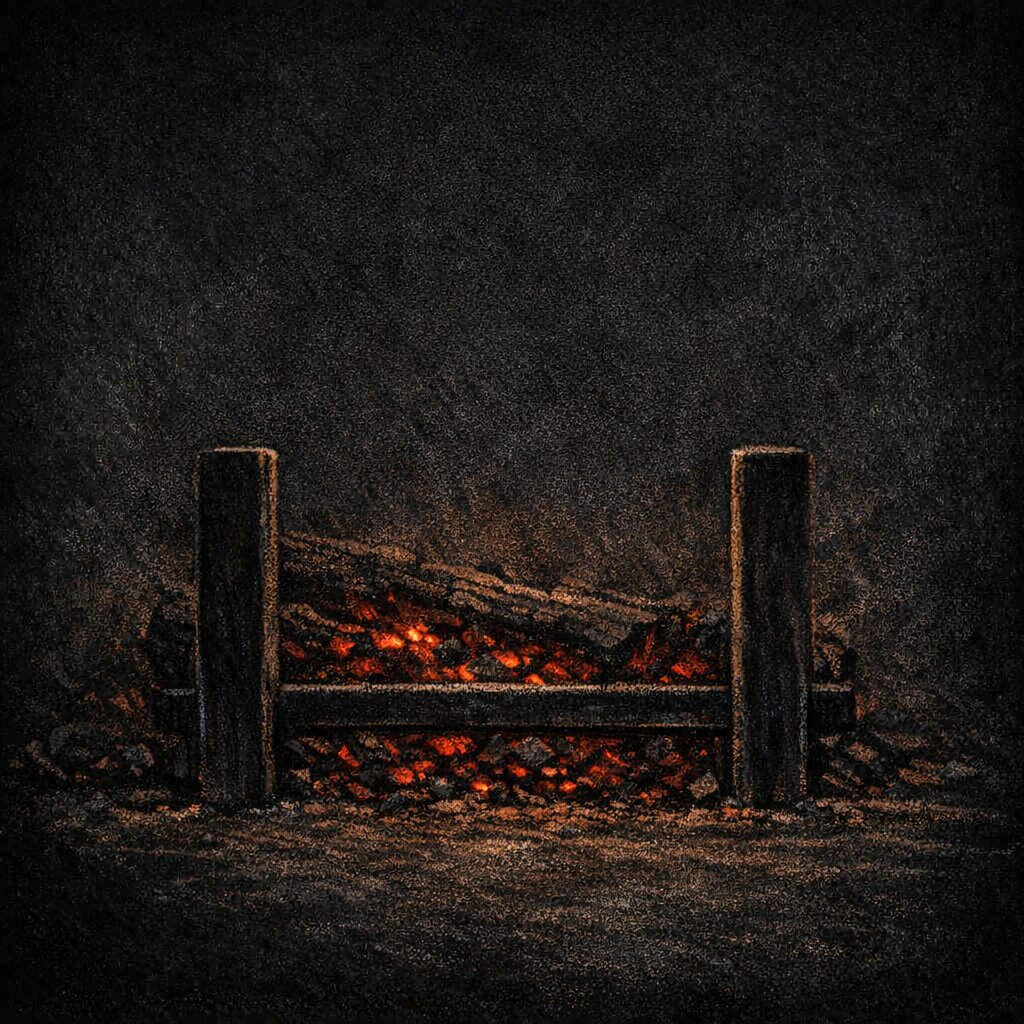
You already know the theology. You have heard that the fire purifies, that the dross must go, that what remains will be gold. You may even believe it. But right now, in this moment, you are not looking at gold. You are watching something burn that you love.
And it was dross.
I am not going to soften that. I have had things I loved burned away. I still have things I love on fire. And they were lies. Every one of them. The scaffolding I built to survive, the self-reliance I called maturity, the coping mechanisms that kept me functional when I had nothing else - they kept me alive, and they were not of faith. "Whatsoever is not of faith is sin" (Romans 14:23) - it does not leave a middle category. They were broken cisterns. They replaced trust in God with trust in myself, and the fact that they worked for a season does not change what they were.
A lie that keeps you standing is still a lie. And a lie can never produce freedom. Only more bondage. The thief steals, kills, and destroys - and lies are his instrument. Every lie you hold onto is a handle he grips. The fire is not taking something neutral from you. It is taking something that was killing you. It has to go. Not because God is cruel, but because He refuses to let the thing that is destroying you stay in your hands just because you have learned to love it.
So yes. It is dross. All of it.
And the grief is real. I know that too.
Both of those things are true at the same time, and you do not have to collapse them into one or the other. The dross was woven into your life. It was tangled with your identity, your relationships, your sense of who you are. Some of it you chose. Some of it was done to you - lies believed because someone you trusted told them to you before you had the capacity to evaluate them. Either way, the fire does not negotiate. It burns what cannot survive the heat. And the burning of a thing you loved - even a thing that was killing you - is still loss. Real, felt, grievable loss. It is painful in the worst way. And that is ok. You will not die from pain - especially if someone is sitting beside you in it. And you know someone is sitting beside you, the One who has promised never to leave you or forsake you.
There is a language for this, and it is older than your grief. "My tears have been my meat day and night" (Psalm 42:3) - the psalmist does not describe the grief from a safe distance; he is in it, fed by it, and he says so to God. And when he turns on his own soul the way you have turned on yours - why am I still this sad, why can I not move past it - he does not shame it into silence. He asks it the honest question: "Why art thou cast down, O my soul? and why art thou disquieted within me?" (Psalm 42:11). And David, further down still, will not pretend the wait is short: "How long wilt thou forget me, O LORD? for ever?... How long shall I take counsel in my soul, having sorrow in my heart daily?" (Psalm 13:1-2). How long is a prayer. Scripture is not embarrassed by it, and has left it in the book for you to borrow when your own words run out.
Job sat in ashes and scraped his sores with a broken pot. Listen to what he said - not the part that gets preached, not the resolution. The raw middle.
"Let the day perish wherein I was born, and the night in which it was said, There is a man child conceived. Let that day be darkness." (Job 3:3-4)
"I will not refrain my mouth; I will speak in the anguish of my spirit; I will complain in the bitterness of my soul." (Job 7:11)
God did not rebuke Job for the anguish. He rebuked the friends - the ones who invented false explanations for the suffering, who manufactured sins Job had not committed, who turned his grief into a tribunal. Their theology was wrong. Job's honesty was not the problem.
But here is the part that matters: God DID answer Job. From the whirlwind. And the answer was not comfort - it was truth. "Where wast thou when I laid the foundations of the earth?" The truth was bigger than Job's grief, bigger than his understanding, bigger than his demand for explanation. And when Job saw it - when the truth arrived in full force - it did not deepen his bondage. It set him free. "I have heard of thee by the hearing of the ear: but now mine eye seeth thee."
Truth freed him. Not softened truth. Not delayed truth. Not truth held back until he felt ready to hear it. The full, unvarnished, overwhelming truth of who God is - spoken directly into the ashes where Job sat.
Your grief is not the problem. But if someone tells you that what is burning is not really dross - that the lies were understandable, that the self-reliance was just how you survived, that you should not feel the weight of what the fire is exposing - they are Job's friends with better manners. They are handing you a gentler lie. And a gentle lie is still a lie, and a lie always tightens the chain. Truth is what sets free. Only truth. Always truth.
So what do you do with grief that is real and a diagnosis that is true?
You do what Christ did at the tomb of Lazarus. You weep.
He knew what He was about to do. He was minutes from calling a dead man back to life. The outcome was already certain - settled before He arrived, settled before Lazarus died, settled before the foundation of the world. And He wept anyway. Not because the death should not have happened. Because death is an enemy. Because the curse is real. Because the damage that sin does to the people God loves is grievable even when the remedy is in hand.
"Jesus wept." (John 11:35)
He did not weep because He lacked theology. He wept because His theology was perfect. He saw death for exactly what it was - an enemy, an intruder, a consequence of the fall - and He grieved it while holding the resurrection in His hands. The grief did not contradict the truth. The grief was produced BY the truth. He could see both what was lost and what was coming, and the seeing of both at once is what tears are for.
If Christ can name death as an enemy AND weep over it AND raise Lazarus from it - all in the same hour - then you can name the dross as dross AND grieve its burning AND trust that what remains will be gold. You do not have to choose between honesty about the diagnosis and honesty about the pain. The fire is burning what must burn. And it hurts. And God is not offended by the hurt.
Your tears are not an offense to Him. He does not look past them to reach the gold. The refiner who sits beside the crucible - who watches the metal, who controls the heat, who will not leave the room - that refiner sees every loss. The cost is witnessed. Every single piece of it. He does not look away when the dross burns, and He does not require you to look away either.
"For the Lord will not cast off for ever: but though he cause grief, yet will he have compassion according to the multitude of his mercies. For he doth not afflict willingly nor grieve the children of men." (Lamentations 3:31-33)
He continues to act in ways that expose our grief. He does not stop, not because He enjoys our grief but because that grief is necessary. The compassion He offers never fails. And the space between the grief and the compassion - the space where the fire is still burning and the gold is not yet visible - that is where you are right now.
"They that sow in tears shall reap in joy." (Psalm 126:5)
The tears are the sowing. The joy is the harvest. You are not at the harvest. You are on your knees in the dirt with tears running down your face and seed falling from your hands, and the field is empty, and the joy is nowhere in sight. The promise says it will come. The promise does not say you have to see it from here.
What you lost was real. The grief is real. The dross is real. The fire is doing what the fire does - burning away what is not gold, what is not of faith, what cannot survive the presence of a holy God. And the truth of that diagnosis does not cancel the grief any more than the grief cancels the truth. They stand together. They have always stood together. The same God who sends the fire collects the tears.
He does not ask you to stop crying. He asks you to stop building with the lies - because the rebuild cannot start while you are still laying them into the foundation. And then He asks you to allow Him to rebuild in purest gold.
Stay in the fire. Grieve what is burning. And let it burn. He is here with you in this very place - He has promised He always will be. And I can say that I too have met with Him here, and that His grace is indeed always sufficient.
In igne vigebo.