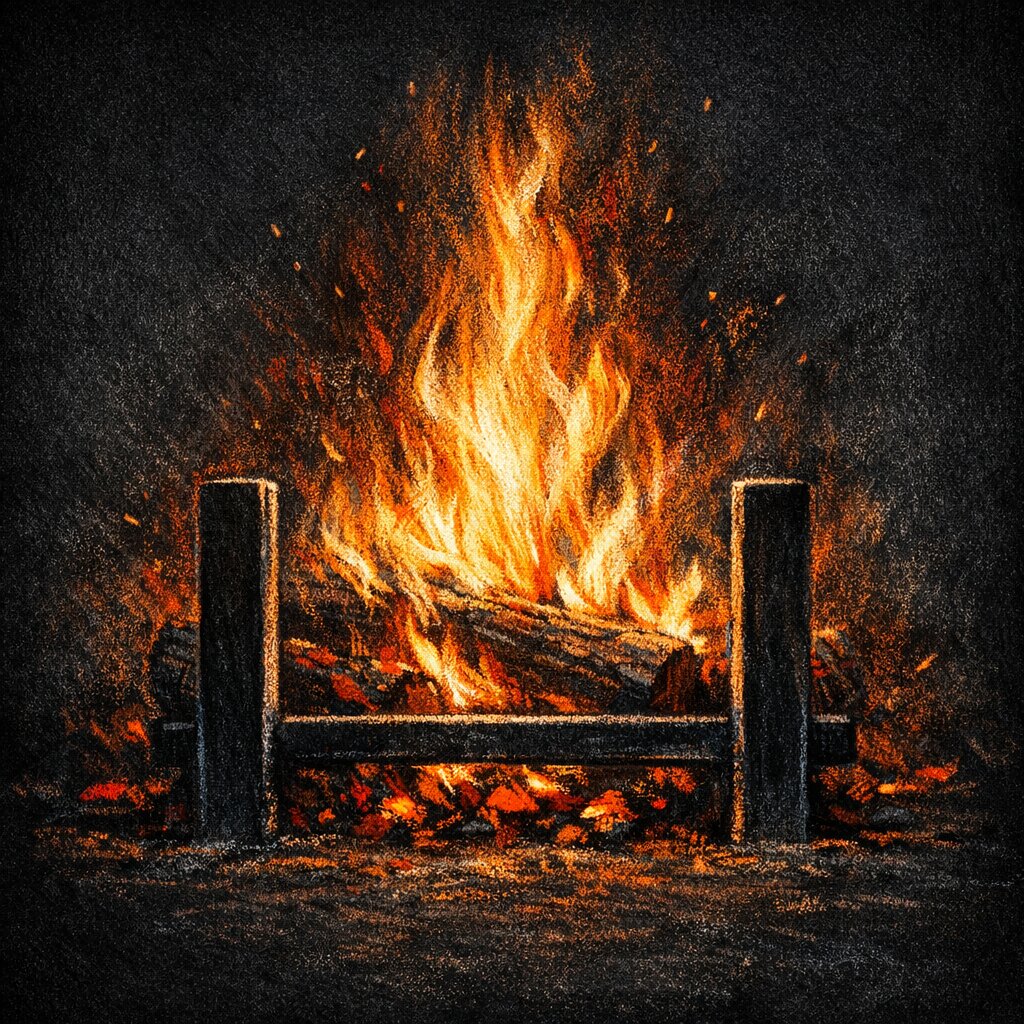
Refining alone does not make you ready.
The dross is gone. The impurities have burned away. What remains is pure - purer than you have ever been. And if you expected the fire to end there, if you thought the refining was the whole of it, then what comes next will surprise you. Because the fire does not stop when the metal is refined. You may in fact be drawn out of the flames, but then the smith picks up his hammer.
After the dross has been refined away (or maybe even while that process yet continues) a second work begins. Forging. The refiner sat and watched; the smith stands and strikes. Refining removed what should not be there. Forging shapes what remains into something useful. "Take away the dross from the silver, and there shall come forth a vessel for the finer" (Proverbs 25:4). A vessel for the finer - raw stock handed to the smith, not the finished thing. Not yet. The dross is gone, but the metal still needs to be bent, hammered, shaped into the thing it was always meant to become.
And what the forging targets is not impurity. The impurity is gone. What the forging targets is your grip on the shape that is - the instinctive, desperate, often white-knuckled grip on your own self in the form that it currently holds. The grasp on the idea that who you currently are is who you should be that you have mistaken for wisdom your entire life.
The False Structure
You built something. Everyone does. Over the course of a life lived in a world that wounds, you constructed a structure - coping mechanisms, self-reliance patterns, protective walls, strategies for minimizing exposure to the things that hurt. And it worked, after a fashion. It got you here. It kept you functional. It may even have kept you alive.
And it has to come down.
Not because you are stupid. Not because you lacked good intentions. But because the structure was always false - built by a fallen builder on a fallen foundation with fallen materials. "There is a way which seemeth right unto a man, but the end thereof are the ways of death" (Proverbs 14:12). It seemed right. It felt responsible. "Protect yourself" sounds like wisdom. "Rely on no one" sounds like maturity. "Trust your own judgment" sounds like strength. And every one of those instincts is a path that leads, eventually, to death - not because the desire to survive is evil, but because survival pursued on your own terms, in your own strength, from your own resources, is a cistern that cannot hold water.
Jeremiah saw it with devastating clarity: "For my people have committed two evils; they have forsaken me the fountain of living waters, and hewed them out cisterns, broken cisterns, that can hold no water" (Jeremiah 2:13). Two evils, not one. You turned from the living source AND you built your own replacement. The grip is always both - a turning from and a turning to. You left the fountain and built a reservoir, and you have been so busy maintaining the reservoir that you forgot the fountain was there. And the reservoir leaks. It has always leaked. In fact it leaks so badly it is not able to keep any water. You have spent your life patching a container that was never designed to hold what you need.
This is what the forging exposes. Not sin in the way you usually think of it - not the obvious transgressions that the refining already addressed. Something deeper. The entire operating system of self-preservation that runs beneath your conscious choices. The assumption that you are the one responsible for your own survival. The belief - so deeply embedded it feels like reality itself - that if you let go, you will fall, and no one will catch you.
The prophet Jeremiah drew the contrast in terms you cannot miss: "Cursed be the man that trusteth in man, and maketh flesh his arm, and whose heart departeth from the LORD. For he shall be like the heath in the desert... Blessed is the man that trusteth in the LORD, and whose hope the LORD is. For he shall be as a tree planted by the waters, and that spreadeth out her roots by the river" (Jeremiah 17:5-8). Notice the grammar. It does not stop at "blessed is the man that trusteth in the LORD." It presses further: and whose hope the LORD is. Not hoping in God as a resource you reach for when your own runs out. Making Him your hope - your source, your ground, your reason for being and doing. The difference between those two things is the entire distance between the heath in the desert and the tree by the water. And the grip - the self-preservation you have been calling wisdom - is what keeps you in the desert.
What the Grip Costs
Christ did not leave this ambiguous. He drew the line with a clarity that most of us spend our lives trying to soften:
"Whosoever will come after me, let him deny himself, and take up his cross, and follow me. For whosoever will save his life shall lose it; but whosoever shall lose his life for my sake and the gospel's, the same shall save it. For what shall it profit a man, if he shall gain the whole world, and lose his own soul?" (Mark 8:34-36)
The grip does not save you. It costs you everything. The very thing you are clutching - your survival, your safety, your carefully maintained control over your own existence - is the thing you must release to follow Him. And the paradox that grinds against every instinct you have is this: saving your life is how you lose it. The tighter you grip, the more slips through your fingers. The thing you refuse to surrender is the thing that is slowly suffocating you.
You cannot embrace an unlimited calling while counting the cost to yourself. Self-preservation and remaining are mutually exclusive. You cannot stay in the fire while clutching your own escape. The cost of discipleship is total - renounce all, bear your cross, hate even your own life. That is not hyperbole. It is not dramatic language meant to shock you into attention. It is the price of admission. And the forging is where you pay it.
"Fear not them which kill the body, but are not able to kill the soul" (Matthew 10:28). The fear that drives the grip is fear of the wrong thing. The body can be destroyed - and the grip exhausts itself trying to prevent that destruction. But the soul is held by another. The grip tries to protect what is already lost and in so doing endangers what truly matters. It is a soldier guarding an empty vault while the treasury burns.
Death to Self
There is a reason Christ used the language of death for what happens next.
"Verily, verily, I say unto you, Except a corn of wheat fall into the ground and die, it abideth alone: but if it die, it bringeth forth much fruit. He that loveth his life shall lose it; and he that hateth his life in this world shall keep it unto life eternal" (John 12:24-25).
The grain of wheat that refuses to die remains intact. Whole. Preserved. And alone. And fruitless. The grip keeps you alive - technically, functionally, biologically alive - but it keeps you alone and barren, disconnected from true life. The shell that protects the seed is the same shell that prevents the root from breaking through. Death is not the end of the grain. It is the condition for everything that comes after.
Paul understood this. Everything he had - his pedigree, his education, his status, his accomplishments - he counted as rubbish. Not because those things were evil. Because the surpassing worth of knowing Christ made everything else look like garbage by comparison. His grip broke not through deprivation but through desire - he saw something more valuable than what he was holding, and his hands opened. Jesus speaks of this very idea in the parable of the pearl of great price - that man bankrupted himself to acquire something of inestimable value.
Finally this dying is not a single event. It is a posture. Paul called it "always bearing about in the body the dying of the Lord Jesus, that the life also of Jesus might be made manifest in our body" (2 Corinthians 4:10-11). Always bearing about. The forging is not a moment you pass through and leave behind. It is the ongoing death of the part of you that insists on surviving on its own terms, so that the life of Christ can be made visible in the space your self-preservation used to occupy.
Abraham and Isaac
We need to talk about Genesis 22. Because if Job is the definitive case study in refining, Abraham and Isaac is the definitive case study in forging - and it will wreck every comfortable reading of what it means to release the grip.
God had given Abraham a promise: a son. Not just any son - the son through whom all the nations of the earth would be blessed. The impossible son, born to a man a hundred years old and a woman who had been barren her entire life. The son Abraham had waited decades for. The son who WAS the promise.
And then God said: "Take now thy son, thine only son Isaac, whom thou lovest, and get thee into the land of Moriah; and offer him there for a burnt offering" (Genesis 22:2).
Stop and feel the weight of that. God did not ask Abraham to give up something evil. He did not ask him to surrender a sin or release an evil or confess a failure. He asked him to give up the promise. The very thing God Himself had given. The thing Abraham had waited his entire life for. The thing he loved most in all the world.
The forging targets what you value most. Not what you value least. Not the things you would gladly throw into the fire because you were tired of carrying them. The thing you grip hardest. The thing that, if you are honest, you value more than the God who gave it to you. The forging asks: do you love the gift, or do you love the Giver? And the only way to answer that question truthfully is to be asked to put that gift on the altar.
Abraham went. He built the altar. He bound his son. He raised the knife. And the angel stopped him:
"Lay not thine hand upon the lad, neither do thou any thing unto him: for now I know that thou fearest God, seeing thou hast not withheld thy son, thine only son from me" (Genesis 22:12).
Now I know. Not "now I see that you have correct theology." Not "now I see that you attend the right services." Now I know that thou fearest God. The grip broke. Abraham's hand was open. He did not withhold the thing he loved most - and in that moment, the forging was complete.
But here is the part that makes this more than a story about obedience. The writer of Hebrews tells us what was going on inside Abraham's mind during that walk up the mountain: "Accounting that God was able to raise him up, even from the dead; from whence also he received him in a figure" (Hebrews 11:19). Abraham's grip did not break because he stopped caring about Isaac. It broke because he trusted the one who asked him to let go. He believed that even if the knife fell, God could raise the dead. The release was not into despair. It was into trust.
That distinction changes everything. The grip does not break because you become indifferent to what you are holding. It breaks because you see, finally, that the hands asking you to surrender what you treasure are safer than your own.
And notice what Abraham did not stop doing. He climbed the mountain, built the altar, bound his son, raised the knife - every act of obedience, all the way to the edge. He released the outcome, not the work. This is the pattern the forging burns in: "the horse is prepared against the day of battle: but safety is of the LORD" (Proverbs 21:31). You keep preparing the horse - the disciplines stay, the obedience stays - and you hand the victory to the One who alone can give it. Trust is not the end of effort; it is effort with the outcome surrendered - what the fire teaches every time you cannot see how it ends and choose to believe He is good anyway: "though he slay me, yet will I trust in him" (Job 13:15). That trust is the root rest grows from; the hand that has stopped clawing for the outcome is nearer to rest than it knows.
The Potter's Hands
From your side, the forging feels like dying. From God's side, it looks like pottery.
"But now, O LORD, thou art our father; we are the clay, and thou our potter; and we all are the work of thy hand" (Isaiah 64:8). You are the clay. He is the potter. The clay does not choose its shape. It does not get a vote on whether it becomes a bowl or a pitcher or a cup. The potter's hands are not asking for your input. They are shaping you into what He knows you need to become.
And when the clay resists - when it stiffens, when it refuses to yield to the pressure of the potter's hands - it does not prevent the shaping. It makes it more painful. Jeremiah watched a potter at work and saw the vessel spoil under the potter's hands. The clay would not cooperate. And the potter did not throw it away. He crushed it down and remade it into another vessel, "as seemed good to the potter to make it" (Jeremiah 18:4). The spoiled vessel was not discarded. It was reworked. But the reworking was harder than the original shaping would have been.
The grip IS the clay talking back to the potter. Every time you stiffen against His shaping, every time you insist on your own design, every time self-preservation tightens your grip against the pressure of His hands, you are the clay saying, "Why hast thou made me thus?" or "I have a better idea". And the potter does not answer the question. He does not owe the clay an explanation. He simply continues to shape it.
And here, finally, the words that have been building across every movement reach their deepest and most costly meaning:
"Not my will, but thine, be done."
In Movement 1, those words meant accepting the fire - stepping into the address you would never choose. In Movement 2, they meant surrendering what the fire exposed - opening your hands as the dross burned away. Here, in the forging, they mean releasing self-preservation itself. The last thing. The deepest thing. The grip that underlies every other grip. This is the moment the human will aligns with the divine purpose. The clay stops talking back. The hands open. And the potter, at last, can shape the vessel without resistance.
What Becomes Possible
And now - only now - something extraordinary opens.
The release is not into emptiness. You do not let go of self-preservation and fall into a void. You let go and discover that the ground was always there - that God Himself is the ground, and He always was. "He only is my rock and my salvation: he is my defence; I shall not be moved. In God is my salvation and my glory: the rock of my strength, and my refuge, is in God" (Psalm 62:6-7). What the grip tried to provide - safety, stability, protection, purpose - God actually is. The broken cisterns are replaced by the fountain of living waters. The heath in the desert becomes the tree by the water. Not because your circumstances changed, but because your source did.
"For to me to live is Christ, and to die is gain" (Philippians 1:21). This is the posture after forging. Life is no longer about survival. It is about Christ. And death - the thing the grip fought so desperately to prevent - is gain. Not loss. Not tragedy. Gain. Because the one who has released self-preservation has nothing left to lose and everything to give.
"They which live should not henceforth live unto themselves, but unto him which died for them, and rose again" (2 Corinthians 5:14-15). The grip was living for yourself. The release is living for Him. And when you live for Him, the fire is no longer a prison you need to escape. It is a post you are assigned to. A vessel for honorable use, set apart as holy, useful to the master, ready for every good work.
The forging does not make you stop feeling the heat. It makes you stop fleeing from it. You can now embrace an unlimited calling without regard for the inevitable cost, because the thing you were most afraid of losing - yourself - has already been laid on the altar. And the one who asked you to lay it there has proven Himself faithful. He caught Abraham's hand. He walked in the furnace with Shadrach, Meshach, and Abednego. He sweat blood in the garden and drank the cup to the dregs and rose on the third day. He has never failed to be present in the fire. He has never failed to bring His people through.
You can now stay. Not because the fire has stopped, but because the grip has broken. And with hands finally open - hands that are no longer clutching your own survival - you are ready to receive what the fire was always meant to give you.
But that is the next movement. The purpose that arrived late. The reason you were called to this fire in the first place.
In igne vigebo.