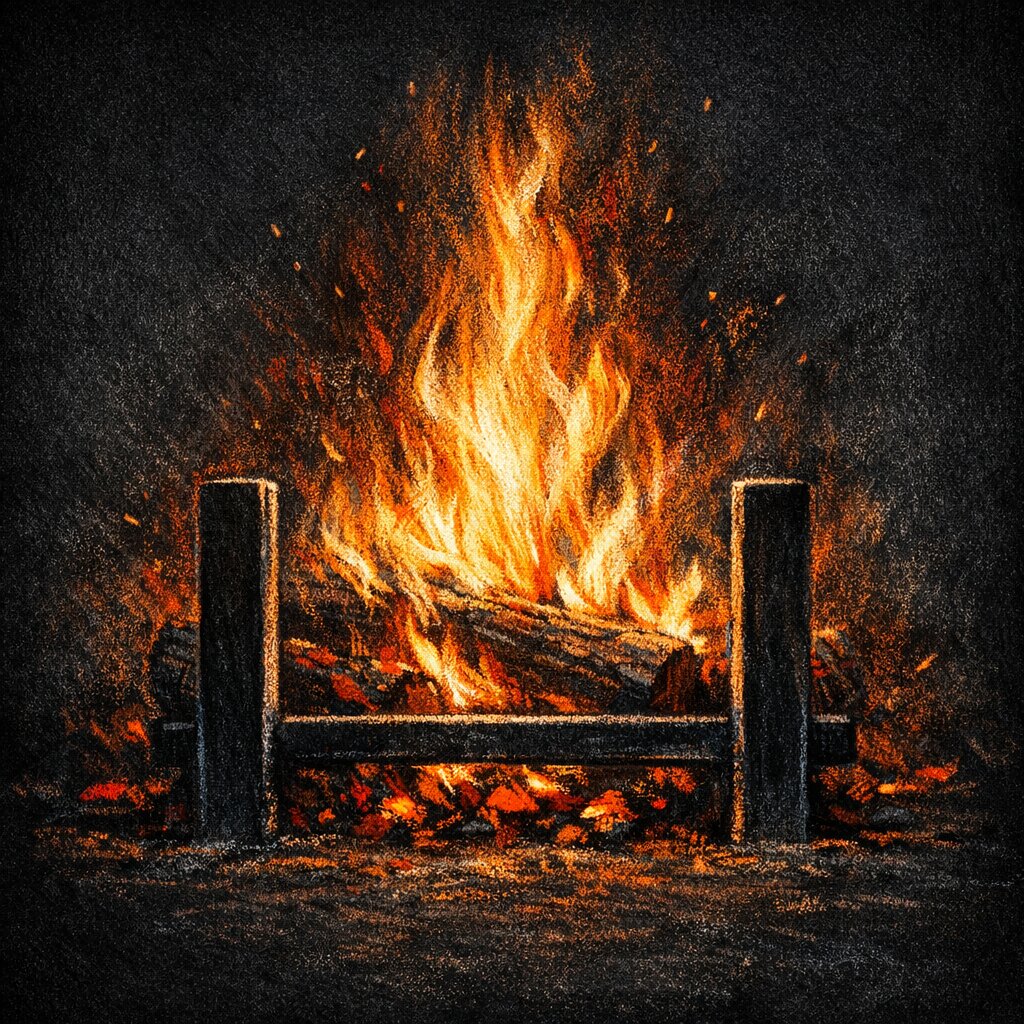
Only now is it possible to grasp true purpose.
The grip is broken. Self-preservation is no longer the operating system. The dross has burned away, the metal has been shaped, and you are still here - not because you could not leave, but because you have stopped trying. "For to me to live is Christ, and to die is gain" (Philippians 1:21). That was the posture at the end of the forging. It is the beginning of everything that follows.
And what follows may surprise you. Because now - only now, after the calling you resisted, the refining you endured, the forging that broke your grip and reformed it anew - now you can see something that was invisible before. Purpose, not the purpose you imagined for yourself. Not the purpose you grasped (preservation and survival). No, this purpose is the one that was always waiting for you to be still enough to see it. This purpose is the one that you could not even see until you let go of the false purpose that you had already appropriated. Now that you have set that down, and only now, is it possible to see true purpose, and to reach out for it.
It arrived late. Or so it seems. In truth, it was always there and your recognition of it could not have arrived any sooner.
Why Purpose Came Late
The fire could not show you purpose while there was still dross to be burned away. You were not able to discover it while your character was being shaped, while your hands were still white-knuckled around your own survival. Purpose requires a stillness that running cannot produce and self-preservation will not permit. You cannot see what the fire is building while you are trying to escape it. You have to stop. And you have to stay stopped.
"Late" is a perspective problem. From inside the fire, purpose feels overdue - cruelly delayed, perhaps deliberately withheld. From the vantage point of the one who placed you here, purpose arrived exactly when it could be received. "He hath made every thing beautiful in his time" (Ecclesiastes 3:11). The timing was never wrong. Your readiness was.
And now comes the harder instruction - the one that sounds almost absurd after everything you have been through: "Trust in the LORD, and do good; so shalt thou dwell in the land, and verily thou shalt be fed" (Psalm 37:3). Dwell. Stop looking for the exit. Stop scanning the horizon for a transfer, a reprieve, a different assignment. Dwell in the land you have been given - and there, in the dwelling, you will be fed. Provision is promised to the one who stays, not the one who runs, and remaining is where purpose lives.
When the Heat Is All You Can Feel
But even after you stop running, the heat can and at times will dominates your attention. And I will not minimize that.
The fire is real. The discomfort is real. Often it is not merely discomfort - it is the absence of all earthly comforts. Even the Son of Man had nowhere to lay His head. If He lived without a pillow, you should not be surprised when the fire strips yours away. You are not weak for feeling the heat. You are human. And the fire you are sitting in was designed for metal, not flesh. The fact that it hurts is not a sign that something has gone wrong. It is a sign that you are exactly where you are supposed to be.
The danger is not the heat itself. The danger is that the heat narrows your attention until it is the only thing you can see. When that happens - and it will - you start asking the wrong question. "How do I get out?" replaces "What is my staying enabling?" The fire did not get hotter. Your vision got smaller. And in the constriction, purpose fades to abstraction.
And more is at stake in that question than a narrowed vision. "How do I get out?" - asked long enough, believed deeply enough - can cost you the rest that was yours to enter. This is the sober warning of Hebrews: "Let us labour therefore to enter into that rest, lest any man fall after the same example of unbelief" (Hebrews 4:11). The generation God redeemed out of Egypt stood at the border of the land and would not go in - "they could not enter in because of unbelief" (Hebrews 3:19). They were delivered; they were never disowned. But they spent their lives restless in the wilderness, because they would not trust their way into the rest on offer. Hear this exactly: the danger is never that you will lose your salvation - that is settled, held by a hand stronger than yours. The danger is that you can be a saved man, spend your whole life in the fire, and never once enter the rest that was always yours - because you would not stop striving for the door.
Paul knew this constriction intimately. "We are troubled on every side, yet not distressed; we are perplexed, but not in despair; persecuted, but not forsaken; cast down, but not destroyed" (2 Corinthians 4:8-9). Read his qualifiers carefully. He does not deny the trouble - he limits its reach. Troubled, yes. Distressed, no. Perplexed, yes. In despair, no. Cast down, yes. Destroyed, no. The fire touches you. It does not consume you. There is a line it cannot cross, and the one who set that line is the same one who allows the fire.
And then Paul says something that, from inside the furnace, sounds almost offensive: "Our light affliction, which is but for a moment, worketh for us a far more exceeding and eternal weight of glory; while we look not at the things which are seen, but at the things which are not seen" (2 Corinthians 4:17-18). Light. Momentary. This is a man who was beaten, shipwrecked, stoned, imprisoned, hungry, cold, and pressed on every side by the anxiety of the churches. And he calls it light. He calls it momentary. Not because he is numb. Because he can see something you cannot see yet - an eternal weight of glory that makes the heaviest fire feel like a feather by comparison. The reframe is not denial. It is perspective. And perspective is what remaining gives you access to.
Abide
There is a word in Scripture that carries the entire theology of remaining in a two syllables.
"Abide in me, and I in you. As the branch cannot bear fruit of itself, except it abide in the vine; no more can ye, except ye abide in me. I am the vine, ye are the branches: He that abideth in me, and I in him, the same bringeth forth much fruit: for without me ye can do nothing" (John 15:4-5).
Abide. Not "try harder." Not "endure through sheer willpower." Not "grit your teeth and hold on." Abide. Stay connected. The branch does not produce fruit by straining. It produces fruit by remaining attached to the vine. The sap flows. The life comes through the connection. And apart from that connection - apart from the vine - you can do nothing. Not "you can do less." Nothing.
This is the secret the fire has been teaching you since Movement 1. Remaining is not an act of heroic endurance. It is an act of sustained connection. The branch that abides does not white-knuckle its way through the growing season. It simply stays where it is, receiving what the vine provides. The fruitfulness is a byproduct of the abiding, not a reward for the effort.
You have need of endurance - Scripture is clear about that. But the endurance that is asked of you is not the endurance of a man carrying a load he cannot bear. It is the endurance of a branch that stays connected to its source when everything around it says to detach. The waiting is real. The strength is renewed in the waiting, not after it. Those who wait for the Lord shall mount up with wings like eagles. Not those who finish waiting. Those who wait.
And the vision has an appointed time. If it seems slow, wait for it. It will surely come. In due season you will reap - if you do not give up. The reaping is certain. The condition is not fainting.
"Not my will, but thine." Those words have been building across every movement. In Calling, they were agonizing - the acceptance of a fire you did not want. In Refining, they were the active surrender of what the fire exposed. In Forging, they were the release of self-preservation itself. Here, in Remaining, they settle into something quieter. The agony is past. The surrender is complete. The release has happened. What is left is simply abiding. The posture has become natural. The words have not changed, but the cost has already been paid.
Remaining Is for Others
Here is the part that will reframe everything: your purpose in the fire is not about you.
Paul said it with the plainness of a man who had made his peace with the furnace: "I am in a strait betwixt two, having a desire to depart, and to be with Christ; which is far better: nevertheless to abide in the flesh is more needful for you" (Philippians 1:23-24).
He wanted to leave, and that was not wrong, but he acknowledged the truth that the decision was not his to make, he truly was a bondservant to Christ. Departure would be gain - he had already said so. To die was gain. The fire held no terror for him. The grip was long broken. And yet he stayed. Not for himself. For them. Because his remaining was more fruitful for others than his departure was desirable for himself.
This is the andiron's posture. The fire is not a prison. It is a post.
And the fire you endured becomes the comfort you offer. "Blessed be God, even the Father of our Lord Jesus Christ, the Father of mercies, and the God of all comfort; who comforteth us in all our tribulation, that we may be able to comfort them which are in any trouble, by the comfort wherewith we ourselves are comforted of God" (2 Corinthians 1:3-4). Your fire was never only for you. The comfort God gave you in the furnace - the presence, the sustaining, the not-being-crushed - was given to draw you into a relationship with Him that provided a testimony, an example to next person standing at the mouth of a fire they did not choose. Your staying enables their surviving.
Paul endured everything - beatings, shipwrecks, sleepless nights, hunger, cold, the daily pressure of the churches - and he endured it explicitly for the sake of others. The suffering list he wrote to Corinth was not a complaint. It was a credential. The remaining produced the apostle. Apart from it, no letters. No churches planted. No gospel carried to the Gentiles. No comfort flowing downstream from a man who had been comforted in every kind of fire imaginable. The fire was the forge that made the vessel; the remaining was the vessel's service.
And somewhere in the middle of all of it, Paul discovered something he called a secret: "I have learned, in whatsoever state I am, therewith to be content. I know both how to be abased, and I know how to abound: every where and in all things I am instructed both to be full and to be hungry, both to abound and to suffer need. I can do all things through Christ which strengtheneth me" (Philippians 4:11-13). The secret of contentment in the fire is not stoicism. It is not gritting your teeth until the pain becomes background noise. The secret is a person: Christ which strengtheneth me. The vine. The source. The one in whom you abide. Contentment in the fire is the posture of someone who has stopped counting the cost to themselves because they have found a source that never runs dry. When you at last connect to an infinite source of income, every finite expenditure loses its significance.
The Purpose You Couldn't Have Imagined
Consider the andiron.
It is a piece of metal that sits in a fireplace. It holds the logs. It keeps the fire burning. It enables the warmth that heats the room, the light that fills the space, the flame that cooks the meal. Remove the andiron from the hearth and it is just metal - unremarkable, purposeless, cold. Put it back in the fire and it holds everything up.
Purpose is location-dependent.
You could not have seen this while you were running from the fire. You could not have imagined it while the dross was burning away, while the grip was being broken, while the tool was being forged. The purpose was always there - embedded in the assignment, woven into the address you would never have chosen - but it required your presence in the fire to be fully realized. You had to arrive. You had to be refined. You had to be forged. And then - only then - you could see that the fire was never the punishment. The fire was the post. And your staying in it is what enables everything else to function.
The purpose you were given is bigger than escape. It is larger than survival. It is more meaningful than self. It was always about someone other than you. The fire you sit in holds up something - a family, a church, a ministry, a calling, a community, a generation that will never know your name but will be warmed by the fire you kept burning. You are the andiron. And the fire is not something to fear, it is where you belong.
And here is the last thing the fire asks of you, the subtlest surrender of all. You have given up your name, your sin, your grip. Now give up your need to matter. Underneath all the striving to do something large, something seen, something that justifies you, is one question: is it enough that He is your God? Can you hold the logs no one counts, in the place no one applauds, and be content - not because the work is small in His eyes, but because "whom have I in heaven but thee? and there is none upon earth that I desire beside thee" (Psalm 73:25)? He is the exceeding great reward (Genesis 15:1). When He is enough, you are free - free to be the unseen faithful, useful in the fire and unbothered by the dark around it, because the One who holds you is worth more than being seen.
Eyes Fixed on Jesus
What makes remaining possible is not strength. It is sight.
"Wherefore seeing we also are compassed about with so great a cloud of witnesses, let us lay aside every weight, and the sin which doth so easily beset us, and let us run with patience the race that is set before us, looking unto Jesus the author and finisher of our faith; who for the joy that was set before him endured the cross, despising the shame, and is set down at the right hand of the throne of God" (Hebrews 12:1-2).
He endured. He remained. He stayed in the fire - not because He had no other option, but because the joy that was set before Him was worth the cross. The joy was on the other side, and He kept His eyes on it. He despised the shame - not denied it, not pretended it was not shameful, but held it in contempt because the joy outweighed it. And He is seated now. The endurance ended. The race was finished. The remaining bore its fruit.
"Consider him that endured such contradiction of sinners against himself, lest ye be wearied and faint in your minds" (Hebrews 12:3). The cure for weariness in the fire is not a vacation from the fire. It is considering Christ. Looking at the one who went first, who endured first, who remained first. You are surrounded by a cloud of witness - from those who remained before you, who endured before you, who sat in fires they did not choose and held up logs they did not light. Their testimony surrounds you. You are not alone.
And the race has a finish line. Paul saw it: "I have fought a good fight, I have finished my course, I have kept the faith" (2 Timothy 4:7). Fought. Finished. Kept. Three past tenses from a man writing his last letter from a Roman prison, knowing his departure was at hand. He was not rescued from the fire. He finished his assignment in it. The remaining was not endless. It was faithful. And when it was finished, only then was he done.
You are in the fire. You can see your purpose now - not the one you would have chosen, but the one that was always waiting for you. The dross is gone. The grip is broken. You are abiding in the vine, and the fruit is growing, and the people around you are being warmed by a fire that burns as you hold it up.
Stay.
Not because you have no choice. Because your remaining is more necessary than your comfort. Because the fire is not a prison - it is a post. It is not a punishment, it is a calling. Because purpose lives here, and only here, and you are finally able to see it.
And if you have been listening, you may have felt something you do not yet have a name for - the abiding that no longer strains, the desire that has stopped fighting its place, the hands held open. That is not only endurance. It is rest - the first of two - beginning in you while the fire still burns. You do not have it in full here; that waits. But its firstfruits are already yours.
So there is one more movement, and it holds not one rest but two: the rest that has already begun in the fire, and the rest that comes when the fire is finally finished - the promise that it does end, and what waits on the other side.
In igne vigebo.