You were told, at the end of the last movement, that there are two rests - and that the first has already begun in you. Before we speak of the one that is coming, turn around and look at the one you already have. You have been building it the whole way, without knowing that was the work.
Look back down the road. At every movement, the fire asked you to open your hand and let something go - and every time, it gave you something of His in its place.
In the Calling, you gave up your own name - the self that answered to no one, that ran its own life - and received a new one: a son's name, adopted, an heir and not a slave. In the Refining, you gave up the old wanting, the reflex that served sin the moment it rose, and received a new desire - the fear of the Lord, the wish to please Him, an ear tuned to His voice. In the Forging, you gave up your grip on the outcome - the need to control it, to see how it ends - and received trust: the settled knowledge that He is good in the dark, that the hands asking you to let go are safer than your own. And in the Remaining, you gave up the last and most hidden thing - your need to matter, to be seen, to be significant - and received the only sufficiency that was ever going to be enough: Him.
Name, desire, control, glory. Four surrenders, one motion, repeated under four names. And here is what you could not have received at the start, what you would not have believed if you had been told: that letting-go was the rest. Not the reward waiting on the far side of it - the substance of it. A hand that holds nothing of its own is a hand at rest. Even in the fire. Especially in the fire. Not the one who values nothing, but the one who values it so much they willingly surrender it to the very one who can hold it best.
The Rest You Have Been Entering
So name this plainly, speak the uncomfortable truth, since no one else seems to want to. What you have been doing - the surrendering, the opening of the hand, one area at a time - is entering rest. Not earning it. Entering it. "We which have believed do enter into rest" (Hebrews 4:3) - present tense, now, in the fire. The rest is not a place you arrive at when the fire goes out. It is what happens inside you as you stop fighting the fire you are in.
And it is rest with the burden, not rest from it. That distinction is everything, and getting it wrong is what put so many readers of this in the ditch. The yoke does not come off. "Take my yoke upon you... and ye shall find rest unto your souls" (Matthew 11:29) - the rest is found with the yoke on, not laid down. You do not rest because the weight lifted. You rest because you have stopped straining against the weight, and found that the One who gave it is carrying it with you.
The truest picture of it is a garden at night. Christ in Gethsemane did not feel the cup any less than you feel your fire - He felt it more. He sweat as it were great drops of blood; He asked, plainly, for it to pass. He did not numb it, did not minimize it, did not pretend it was small. And then: "nevertheless not my will, but thine, be done" (Luke 22:42). The rest is the nevertheless. The burden named at full weight, and the will handed over anyway. Not the absence of suffering - the presence of surrender inside the suffering. And it is offered to you today: not the cup removed, but the nevertheless made possible.
And this rest is not one more thing to achieve, one more strain on the pile - it is what is left when the straining stops. You do not build rest. You run out of things to clutch, and rest is what remains when your hands are finally empty. When there is nothing of your own left to hold in any area - not your name, not your desires, not your control, not your need to matter - and you are leaning on Him in every one, that entire dependence simply is rest. Not the reward of the surrender; the surrender, seen from the inside. Which is why it never could have come by effort - effort was the very thing being laid down. The establishing is God's own doing, not your endurance: "after that ye have suffered a while," He will "make you perfect, stablish, strengthen, settle you" (1 Peter 5:10) - His hand settling you as you suffer, not a wage your grit earns at the end. To the outside observer it will always appear impossible, but to the one who enters, to him it is the only thing possible.
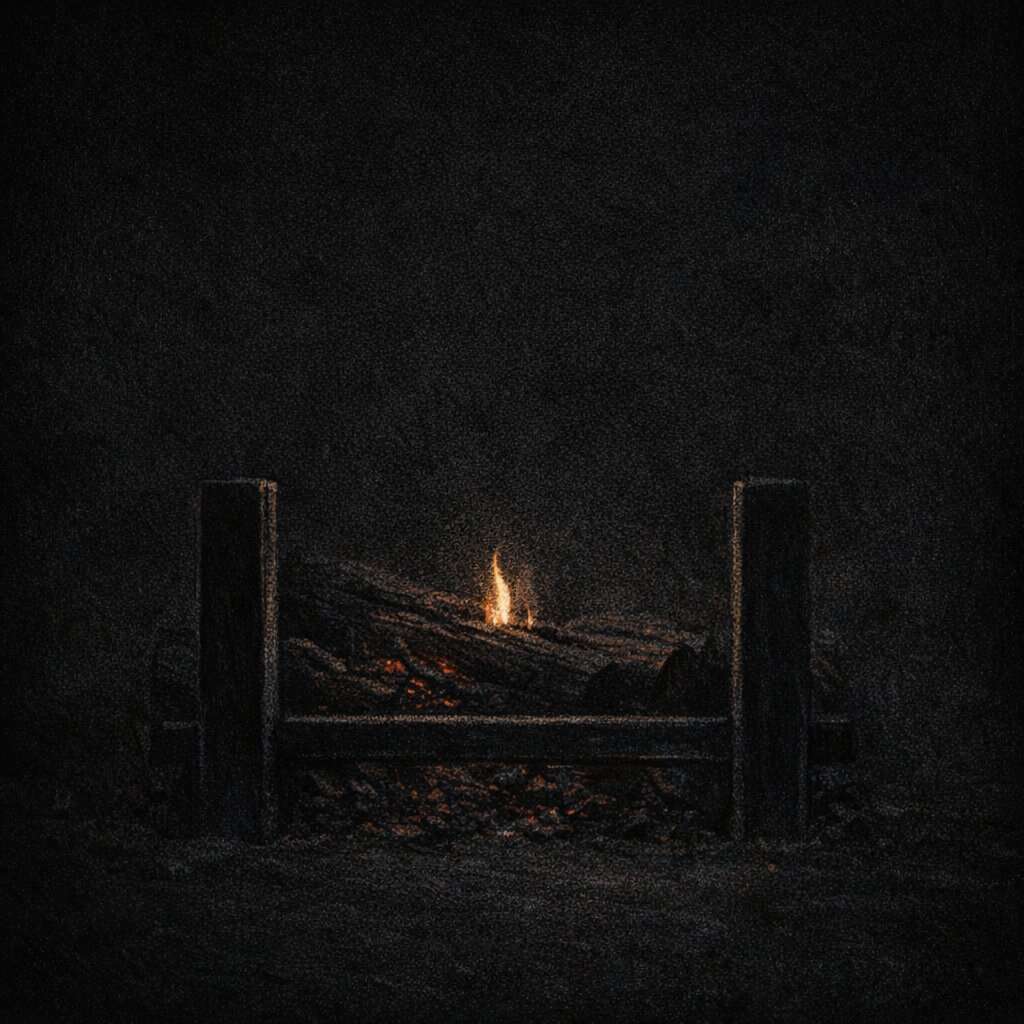
And it is for the here, the now, while the fire still burns. This is what the motto meant all along. In igne vigebo - in the fire I will thrive - was never a promise the fire would cool. It was the claim that a man can be at rest in the middle of it. The andiron does not rest by being pulled from the fire; it rests by ending its fight against being there, holding its logs in the hottest place, exactly where it belongs.
So hear the cost honestly, because a gentler version would be a lie: the heat does not stop. This rest is not the fire going out - that is the other rest, and it is not yet. Anyone who tells you the present rest means the suffering ends is selling you the second rest dressed as the first, and you will feel cheated when the fire keeps burning and conclude rest was never real. It is real. But it is rest in the furnace, not deliverance from it. There is no third thing - no private door out of the heat while you are still alive. There is the rest that holds you in the fire, the rest that comes when the fire is finally out, and nothing in between to lift that flame early.
The Taste and the Feast
But do not mistake the rest you have now for the whole of it. It is real, it is genuine, and it is not the full measure. What you hold in the fire is the firstfruits - "the firstfruits of the Spirit" (Romans 8:23) - the first sheaf of a harvest still coming in. It is the earnest, the down payment: "sealed with that holy Spirit of promise, which is the earnest of our inheritance" (Ephesians 1:13-14). A down payment is not a lesser currency than the full sum; it is the same currency, paid in part, guaranteeing the rest. So the present rest and the coming rest are not two different rests. They are one rest - tasted now, received in full later; the same peace, partial in the furnace, whole past its door.
And the taste is good - genuinely, fully good. "O taste and see that the LORD is good" (Psalm 34:8): not a thin sample of a doubtful thing, but a true mouthful of the best there is. Which is exactly why it makes you homesick. If this - rest in the middle of a fire, dim and broken as it comes to you - is the smallest portion of what awaits, then what waits is past all reckoning. The firstfruits do not only guarantee the harvest; they awaken the hunger for it. That is the groan underneath Romans 8:23 - you have tasted, and the taste has ruined you for anything less than the whole. It comes dim now - "for now we see through a glass, darkly; but then face to face" (1 Corinthians 13:12) - and even the dimness is no flaw but a mark: the pledge is real enough to trust, and partial enough to keep you leaning, hungry, toward the day it is paid in full.
The Rest That Is Coming
And this brings us then to that other rest - the one on the far side of the fire, the harvest the firstfruits were promising all along.
Do not let me tour it for you as though you had already left the furnace; you have not. See it the way a man in the fire sees it - dimly and even out of the corner of his eye, from inside the heat, believed more than beheld. But see it, because it is coming, it is certain, and it is what makes it possible to hold in the fire.
There is a finish line. Paul saw it from a prison cell, his death already near: "I have fought a good fight, I have finished my course, I have kept the faith" (2 Timothy 4:7). Fought, finished, kept - three past tenses from a man still, technically, in the fire. He could see the end, and what he saw was not escape but a crown, and not for him alone. And the work behind that crown is not yours to finish but His: "he which hath begun a good work in you will perform it until the day of Jesus Christ" (Philippians 1:6). What the fire began, He completes - carried all the way to the day Christ appears. And the perfect does not arrive until heaven (when the partial is finally done away).
And measured against what is coming, the fire is lighter than it feels. "Our light affliction, which is but for a moment, worketh for us a far more exceeding and eternal weight of glory" (2 Corinthians 4:17) - light and momentary, said by a man whose body was a map of scars. Not because he was numb, but because he weighed it against eternity, and against that scale the heaviest fire becomes nearly weightless. "Weeping may endure for a night, but joy cometh in the morning" (Psalm 30:5). The night is real. The morning is certain.
There is a rest that remains. "There remaineth therefore a rest to the people of God" (Hebrews 4:9) - not cancelled by the fire, but waiting on the far side of it the whole time. And nothing you bore was wasted: "they may rest from their labours; and their works do follow them" (Revelation 14:13). None lost, not the nights you stayed when you wanted to run, not the tears no person saw (He collects your tears, proof of the suffering, and the endurance). Every one of them follows you home. Christ said it like a bridegroom readying a house: "I go to prepare a place for you... I will come again, and receive you unto myself" (John 14:2-3). A place. Prepared. Yours. And He does not send for you; He comes.
And one day, two words worth more than all the applause you never got: "Well done, thou good and faithful servant... enter thou into the joy of thy lord" (Matthew 25:21). Not "well achieved" - well done: the commendation of faithfulness, of the servant who stayed at his post and held the logs he was given. And note when it is said - at the end, not the middle. It is the word for the one who endured: "he that shall endure unto the end, the same shall be saved" (Matthew 24:13); "be thou faithful unto death, and I will give thee a crown of life" (Revelation 2:10). Not the one who burned brightest for a season, but the one still holding the logs when the fire finally went out. And what waits past that threshold you cannot picture from here: "eye hath not seen, nor ear heard... the things which God hath prepared for them that love him" (1 Corinthians 2:9).
And then the thing the whole fire taught you to want: to see Him. "Now we see through a glass, darkly; but then face to face" (1 Corinthians 13:12) - the dim taste become clear sight. "God shall wipe away all tears from their eyes... neither shall there be any more pain" (Revelation 21:4): every tear you shed in the furnace, wiped away by the hand of the One who sat beside you that entire time. "Behold, I make all things new" (Revelation 21:5) - not all new things, all things new; everything the fire touched, brought through and made glorious. "So shall we ever be with the Lord" (1 Thessalonians 4:17).
And this rest - hear it, because it changes how you carry the fire - cannot be lost. The warning you heard a movement ago fell on the rest you can miss now; it never touches this final one. This rest is held by a grip that is not yours: "I give unto them eternal life; and they shall never perish, neither shall any man pluck them out of my hand... and no man is able to pluck them out of my Father's hand" (John 10:28-29). No man - and that includes you, even on your worst day. The far-side rest is settled. You are not holding on to it; He is holding on to you.
But That Is Not Yet
But that is not yet.
Today, you are here. The fire is not out. The work is not done. Hear the close the way it is actually provided: not a door out, but the completing of what you already hold.
Because the rest is not only ahead of you. It has already begun. You do not have to reach the morning to begin to rest; the first rest is yours tonight, in the dark, with the yoke still on. The desire to depart is real, and not wrong - Paul had "a desire to depart, and to be with Christ; which is far better" (Philippians 1:23). But he stayed - "to abide in the flesh is more needful for you" (1:24) - and so do you, not because you have no longing for home, but because your remaining is still exactly where God placed you, your faithfulness being used by Him to hold someone else's logs up. We walk by faith, not by sight (2 Corinthians 5:7). Today is the faith; the true sight is coming.
So this is where you are, and it is enough: refined, forged, remaining - and now, at rest in the fire. Not rest because the fire stopped. Rest because you have stopped fighting it, and found the One who assigned it holding it with you, and learned that His nearness is worth more than the flames cost. The andiron does not wait to be pulled from the hearth to fulfil its purpose. It thrives where it stands, in the heat, holding what it was made to hold.
In igne vigebo. In the fire, I will thrive. Present tense - because the rest was never only a promise for later. It is the intended way to stand in the flame today.